( This article is quoted from Cabinetmakerfdm.com ).
Experts say this is one of the earliest-known cabinet maker's shops in its original site.
Recently discovered during the remodel of a preschool in Duxbury, Mass., was a surprisingly intact woodworking shop from the late 18th century. The Boston Globe reports the shop, framed in original sills, joists, and pineboard walls, still has two original workbenches. One is pitted with marks from hand tools and the second is a planing bench which lacks tool scars because skilled millwork with wood planes was performed there.
“It's likely to be the earliest known joiner and cabinetmaker's shop on its original site,” anywhere in the United States, restoration carpenter Michael Burrey told the Globe.
The 16-by-32 foot wood shop is on the site of the private Berrybrook School on Winter Street. The school approved to explore the outbuilding, which has been used for storage.
The president of the school's board of directors said Berrybrook had no idea of the building's historical value.
“We really thought nothing of it. We had used it as storage,” Christopher DeOrsay, an architect, told the globe. “We gave [Burrey] a tour. His jaw hit the floor.”
DeOrsay said since then the school has had more than a dozen experts come to see it.
The wall above the bench has shelving to hold the planes. The planing bench also reveals a groove added later to allow craftsmen to install a treadle lathe for turning wood, powered by a foot pedal.
The shop also has its original tool racks for chisels, awls, and brace (hand drill) bits, as well as a rack near the ceiling for handsaws. Holes in the wall board above the joinery bench reveal where awls were stuck to keep them close at hand.
Painted in black on a joist in the shop's small storeroom, large digits spell out a date, “1789.” It may be a construction date, but Burrey says some construction techniques suggest an earlier date.
Sketches and hash marks on another wall shows woodworkers spent long hours at the shop. Someone painted a sketch of a man standing with his back against a wall, one knee lifted, a hand extended. Much of the outline remains, the colors dulled but visible.
“The way the benches are in relation to the windows, how the light comes in to light an area, the location of the tool racks on the walls,” all tell of how the craftsmen used the shop, Burrey said.
Gary Naylor of Hanson, a specialist in antique woodwork and tools, said the shop's interior revealed signs of a Federalist craftsman's workshop.
“When I saw the [foot-operated] lathe there, I knew it was a highly skilled craftsman,” Naylor told the globe. “A lot of different features in the building are untouched, intact. When I turned around and saw the opening for the fireplace, it was all coming together.”
Cuts in the wall board reveal the location and shape of the shop's fireplace, probably removed in the 19th century in favor of a woodstove.
Garrison, who visited the shop with a team of specialists from historical organizations such as Colonial Williamsburg, told the globe that carpenters and cabinet makers were called “joiners” then. He said early American craftsmen worked with wood that came rough from the saw mill, and their first job was to plane it down to a smooth finish.
You can see which bench is the planing bench not only because it's not scarred but also because it's built against the wall farthest from the fireplace, Garrison told the globe. Planing produces shavings likely to become tinder for a spark from the fireplace.
Naylor said property records show that the shop belonged to a well-known housewright and joiner Luther Sampson, in the late 18th century. Genealogy research revealed that Sampson was the craftsman who founded Kents Hill School in Readville, Maine.
Born in 1760 in Duxbury, Sampson served in the Revolutionary War and bought the 60-acre Philips farm on the west side of Duxbury, home of the Berrybrook School today. His high-quality handiwork, experts say, adorns the interiors of many fine houses built in Duxbury in the late 18th century, when the town was home to prosperous sea captains and merchants.
The survey team that visited the shop with Garrison last month concluded the building was worthy of National Historic Landmark status “due to its rarity and integrity,” Garrison told the globe.
He urged preservation of the shop. “We won't get a do-over with this building,” he said.
Preservation costs money, and supporters have applied for a $35,000 grant from Duxbury's Community Preservation Act funds to help pay for an archeological survey of the site, some foundation repair, and to “repair deteriorating hand-hewn sills and joists to stabilize [the] structure.”
“While we have lots and lots of historical houses,” Garrison said in a recent interview, “as a woodworker's shop it's probably the oldest in New England” and possibly the country.
“It's the rarest of the rare. And who knew? Found on the grounds of a preschool.”
DeOrsay said the school's board of directors would be in favor of preserving the shop. “We'll try to find out what the best option is.”
This year the Guild will focus on chairs, their history, design, and manufacture. Using the Guild project chair as a starting point, we will teach basic chair making. All members wishing to build a chair similar to the Guild chair are encouraged to do so. Plans and patterns will be available for a nominal charge.

The 2009-2010 Guild Brochure is available on this web site.
The Eliot School has been teaching since 1676. In 1889 the school focused on manual arts and has been teaching classes in woodworking and other crafts since. The Guild is proud to have formed an alliance with The Eliot School to help continue and support our mutual goal of educating and promoting excellence in woodworking.
The Guild has agreed to co-sponsor several woodworking classes and workshops offered through The Eliot School starting this fall. The fall classes that we are co-sponsoring are: Basic Furniture Design, Furniture Finishing, Gilding & Frame Restoration, and Inlay & Veneer. The workshops are Wood Carving, Wood Turning, and Surface Decoration on Wood. These classes and workshops are taught by professional woodworking instructors. For a full description of the fall classes, instructor, time, and tuition check out The Eliot School's web site. The Eliot School, located in a beautiful residential neighborhood in a building built in 1831 near Jamaica Pond, has a complete and extensive wood shop. Plenty of on-street parking is available.
Also watch for a mini-course on SketchUp for Furniture taught by the Guild's own expert, Jim Russell. This is scheduled for winter term at The Eliot School.
Guild Members will receive at 10% discount on tuition on co-sponsored classes. When registering, please say you are a member of the Eastern Massachusetts Guild of Woodworkers.
Keep up to date on this serious threat. Click Here for more information.
Here is a sketch of the Display Case that was our 2010 charitable project, built by members of the guild.
The project to build boxes of blocks was completed in October. The Clinton Early Childhood Resource Center provides services for children from Clinton and surrounding towns. Many of these families participate in the Parent Child Home Program,and will use these blocks to support their children's early language and social/emotional development. The guild is bringing great joy to a few very young (3 to 4) children by providing them with a very important toy and learning tool.
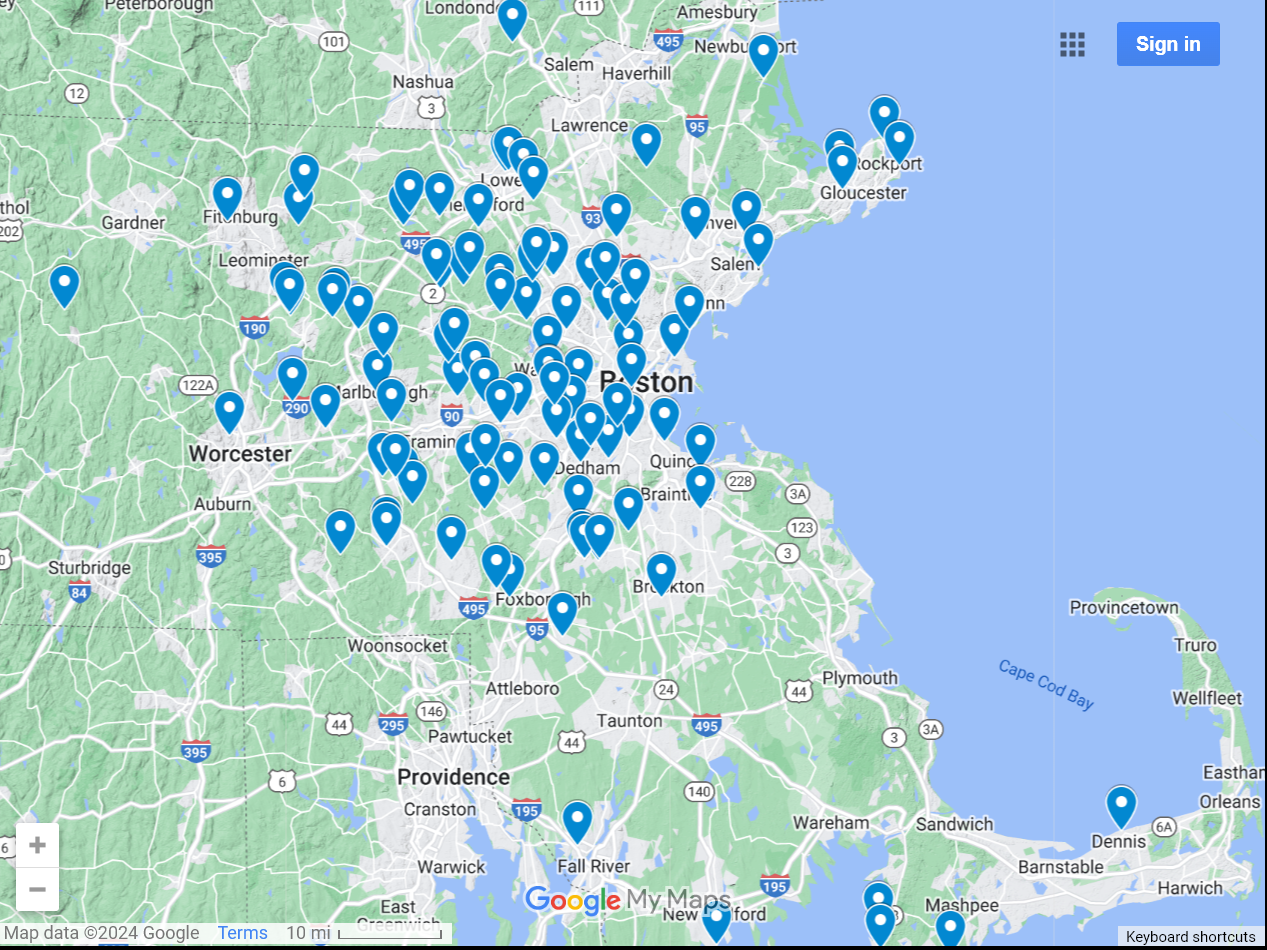
(Click here for Clinton Email and Pictures)The Eastern Massachusetts Guild of Woodworkers (EMGW) is a non-profit organization dedicated to the promotion of excellence in the woodworking community through the sharing of information in the art, technique, and business of woodworking. We aspire to these goals in order to promote and foster interest in our craft for both the aspiring and skilled woodworker.